—
(original interview in french)
This is a translated version of an interview originally done in French. Translating was fairly difficult and as a result, some of the sensibility and poetic nature of Arianes’ answers have been lost in translation.
—
Recently I had the opportunity to speak with someone who I’m greatly inspired by, Ariane Longevial. Ariane is a French photographer who grew up in the south of France with her two brothers, older sister, mother and father – and now lives in Paris. Her work represents a unique style, one that searches for what is true, and for what we often overlook, through the camera lens. Her photos have an incredibly special quality about them, a quality that is very difficult to put your finger on – familiar and strange at the same time.
Ariane explores her unique relationship with the world through the spaces and people that are both close and far from her, and her inner universe. She gives us a look into her life with her series’, for example « Je est une autre » – on her relationship with her partner, or « Presque moi » – on her body image and her battle with cancer. Through her sincere transparency, Ariane invites us to look at life through a different lens, to search for its essence without mythologising or minimising it.

—
Let’s talk about the relationship between you and your camera – is it a battle for you to translate your vision through the lens of your camera?
—
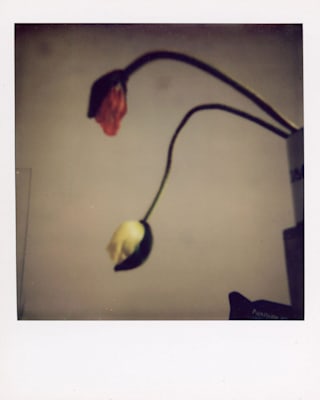
It depends, sometimes it’s very difficult to translate what I want, other times it’s very easy. My relationship with my cameras varies a lot. I work mainly with digital, but recently more and more with Polaroid, especially for my series « Je est une autre ».
As my Polaroid is an old version, I’d have to use flash, which I don’t do. So I have to counterbalance and play with its “defect” and the light. With the Polaroid, it’s harder to bring out what I really want. The lack of light intensity sometimes makes the result capricious. Every time, it’s a challenge, almost a surprise. My photographic style varies a lot and I don’t have any precise artistic direction. I only want to make photos that make me feel an emotion.
I work as if each shot were unique. As if I had no other possibilities. I don’t release the shutter very often, like a film photographer. From time to time, when I release the shutter, I know that the photo will be my favorite of the series. I can’t explain it, but something happens between me and the photo, and I feel that this one will be special. Images haunt my head, both the ones I make and the ones I don’t make.
—
Or is it interesting to look at your vision but in a new form – perhaps something strange but familiar at the same time?
—
My way of seeing things is very different to others, and a lot of people don’t understand my way of perceiving the world. I love the fact that you talk about familiar strangeness in my work, it means that there is indeed something that speaks to you. I doubt very much whether my work speaks to others.
When I take a photo, it’s perhaps more a feeling I capture in myself than a moment in life. I question myself a lot about today’s “colorist” photographers. It seems that the beauty of my work is that I take photos of what is usually described as ugly, uninteresting, and in so doing, give it a soul. I like this idea a lot.
–
When I think about your art, I get the impression that you can find a subject in any space – the street, awards ceremonies, even in yourself. First of all, what are the things that inspire you?
–
Indeed, I think I can find subjects in almost any situation, as long as there’s color and/or form involved.
My inspirations are very broad, starting with my family, cinema and life. I’ve always observed a lot, and I’ve always looked aside from where others look. What really inspires me is the desire to make images as incredible as those of the photographers and filmmakers I admire. I want to find that thing they capture that moves me. Among them, Almodovar, Richard Curtis, Garry Marshall and Sofia Coppola have particularly impressed me with their ability to capture the essence of a feeling, mood or color.

—
So did you find these inspirations through various elements accumulated since your youth or is it a skill you’ve developed?
—
I grew up in the South, in the countryside, and spent a lot of time observing nature. I grew up in a family where we shared a lot of our thoughts and feelings. Being sensitive by nature, I always immersed myself in my families way of thinking, and this helped me to see things differently.
And too, my mother and sister are both greatly interested in art. When I was growing up, my sister would have lists of films to watch for her studies, and I would watch them with her. We could spend a whole week watching Almodovar, I was particularly impacted by his work during my youth.
On the other hand, my mother preferred museums and art history. She would regularly take us on field trips to analyze works of art. The idea was to try to understand the artist and put into words the feelings the work gave us.
Cinema is an important part of my life, and I quickly realized that real people don’t look resemble the characters in films. So I liked to find little links between the fictional world and the real world, which allowed me to invent my own story, starting from scratch every morning. I saw my life as an infinite reel of film. Every day was a new story.


–
How do you go about finding and creating a relationship with inanimate objects? How are you able to bring life to non-living things?
–
For me, all objects are alive, and I like to imagine that they have a soul or personality.
In a way, they are alive because they exude an energy, which is due to the fact that everything we touch, transform and use, captures a small part of us. I recently realized that in my work, apart from subjects deemed “intimate”, I photograph very few humans.
So maybe I’m finally capturing the traces they leave on objects? For me, I like to imagine it’s a kind of memory of the past.

—
How do you capture the essence of a person without mythologising or minimising them?
—
I’m particularly happy to answer this question; you do it by taking them as they are, with all their flaws and strengths. If you don’t judge people, if you connect with them, you can capture their essence.
If I take someones flaws and strengths into account, it’s harder to mystify or minimise them. It just takes the ability to recognise them as a complex and unique being.


—
« Collages » – Is just one example of the more experimental series’ you have – can you explain to me the process by which you conceive your ideas and your approach?
—
For all these series, I don’t have a precise design process, it’s mainly my feelings and desires that speak at the moment.
I love textures, colors and shapes, and too I like to leave my mind completely empty while making certain projects. Collage is just the result of clearing my mind.

—
« Je est une autre » – What have you learned about yourself, life and love through this series, and through lens of your camera?
—
« Je est une autre » is a series of over 80 Polaroids. At the moment, it’s far from finished, but it’s helped me appreciate my body a little more, because the camera is passed from time to time to other people, for example sometimes my partner takes the photos.
This series has allowed me to further develop my photographic work, to dare to take more photos, even if they’re of the simplest things in my life. I tend to get lost in time, so taking photos allows me to find myself again.
It’s thanks to these photos that I remember dates and periods. It has also enabled me to focus on the other person as a way finding my place. My girlfriend is my first relationship. Before her, I hadn’t come out. So I’ve learned a lot through this relationship, but also through this photo series. In short, it’s a way of becoming a spectator of what I’m experiencing, of seeing each scene, of rediscovering this relationship and thus appreciating it doubly, with its new contrasts.


–
« Presque moi » – This is a deeply personal and intimate story from your life that you’ve shared with the world – your battle with cancer as an adolescent and its impact on you now. Your courage and willingness to open up is very inspiring to me. Can you tell me more about your decision to do this series and how you found yourself in these photos?
–
Firstly, thank you.
Well, I did this series when I was a photography school student 3 years ago. I don’t know if the images still correspond to me, because I think I’ve changed my style a lot. It was a way of turning a page, 10 years after my cancer. For me, it felt like it was still hanging off my skin, always trailing behind me. I had the feeling that people I met could only see that about me, and nothing else.
So I decided to put it front and center once and for all. I wanted to let go of this disease that had caught me at a very young age and finally grow up without it. I was accompanied by 2 teachers during my studies. The first told me that he had worked on his own, and that I shouldn’t do something so sentimental. But the second helped me to take the necessary distance to treat this very personal subject appropriately.
I started this series with Fujifilm’s x100v and a 35mm equivalent lens. It enabled me to get very close to my subject, and to bring out what was important to me. The hardest part was showing the project, but it was also the most important. When I showed it to my graduating class for the first time, it liberated me.
—
Regarding the last photo, which is so different to the others in this series. It seems to signify a symbol of personal process – what does this photo of the beach mean to you?
—
Yes, it does. It’s the last image I took, and as I said earlier, I knew instantly that it was the last one and that it would close the series. I think it was on this beach that I finally let go of my cancer. I even think that until this photo, I was hiding behind it, a bit like a shield, and from then on, I understood that there was still plenty of time and life to live. On this beach, I accept the mourning of my adolescence, of the person I could have been.
This photo brings tears to my eyes when I see it again. The beginning of this answer was written some time ago. Since then, I’ve had new health problems, and I can tell you that this picture now gives me the feeling that it has caught up with me, that I had let my guard down too soon. This photo has become very blurred for me. I have the feeling that the disease was too quick for me, that I didn’t have time to turn around and now it’s here again.
So is this series finally over? I don’t know, I’m not sure, but we’ll find out very soon.

Thank you so much to Ariane for her art, her sensitivity and her willingness to open up to me and to the world. We need to find and support truly unique people like her, to remind us why we live.
Many thanks also to Juliette Gros and Orlanda Zuanic, who helped me refine my bad French and write in a way that did Ariane justice.
Here are the websites of Ariane and her partner, Pauline Gosserez – a talented and touching photographer.